Thursday, May 23, 2013

The Devil's Mine

Up to this point the tone of our blog has been pretty reflective of our individual personalities, jovial and light-hearted. I believe that above all, the reason that we decided to go on this journey was to savor the last few drops of a waning youth before the realities of career and family makes our lives serious. We left home looking for adventure, new experiences and more than a few laughs. Without a doubt the experience to this point has delivered.
Getting geared up.
However, today I find myself more pensive, and even humbled, by the experiences of the past few days. At least for me, this youthful expedition of exploration and discovery has had a few unintended side effects. 

We arrived in Bolivia a few days ago, a country that consistently sits among the poorest in the whole world. It often smells of sewage and trash is so scattered about the surrounding landscape one would think that it was their primary cash crop. Politically, it would be flattering to call it 'unstable' since they have changed their government over 200 times in their 180 year history. Looking out the window of our bus as we crossed the border, observing towns and hills rush by I realized the crushing degree of poverty than many people live in. Perhaps 'survive' would be a better description. Surprisingly though, it's humble charm has been captivating. 

One of two guys we met who started working in the mines at 13.
We left Uyuni, a remarkably depressed place, for Potosí, another stop on our way to Brazil. We discovered that the city rested at the foot of a series of mines dating back to the colonial period, and to our amazement, we could spend a day exploring them. Built in the 17th century, the mines are incredibly archaic and (sorry mom) extremely dangerous. Most miners don't last more than ten years because of brutish working conditions. There is no 'company' that runs the place, just individual miners who work on their own, cooperating with other miners to increase profits. As a result there is virtually no safety regulation protecting the workers. On more than one occasion they have received the nickname of 'The Devil's' Mine.' (A 2005 documentary was made about them http://en.wikipedia.org/wiki/The_Devil's_Miner)
Entrance to the mine. Four times a year the portal is drenched in lama's blood. For real.
After meeting our guide we suited up and descended into the mines to experience a day in the life of Bolivian miner. As we descended, we squeezed through a maze of hellish, claustrophobia-inducing tunnels, ever spiraling downward as if built by the devil himself. At our lowest point, some three hundred feet below the surface of the earth, we met a few miners hard at work. As I alluded to earlier, I was supremely humbled when we were introduced to Carlos, a miner the same age as me, who had been slaving in those abysmal caverns since the tender age of 13. 
Justin dives headfirst into a cavern.
Exploring those caves was one of the most extreme things I have ever done but I was happy to leave. When we reached surface and were met by the relieving hope of the afternoon sun all I could think about were Carlos and Hernan and the like, who wouldn't be coming up for another 5 hours. For us it was an afternoon of fun, but for them it is their lives.

I was struck with gratitude for all that I have. I am grateful that in my early years my biggest problem was making the basketball team, rather than being in such a dire straights that my survival as a young boy was contingent upon risking my life in a silver mine.  I am grateful that I can go to school and get and education. I am supremely grateful that, by pure chance, I was born into a family and a country where opportunities are limitless.
Dustin and Justin pause to breath. Since the mine is built into a volcano temperatures are high and oxygen is scarce.

When all is said and done, We know we will come home with a new perspective of the world.
Most of the holes are so small you have to crawl on hands and knees to get through.


After.

Silver is one of the primary minerals produced by the mine.

Justin chewing some coca leaves. All the natives chew them to curb hunger, fight the altitude and for a quick energy boost.


We met a miner name Hernan who let us try our hand at mining. We failed miserably. 


The group with Hernan.

Tuesday, May 21, 2013

The Natural Splendor of the Salar de Uyuni

The past few days have been crazy as we entered Bolivia. On the way from Puno, we had to switch busses in Copacabana, take a ferry across Lake Titicaca, and then cross the border on foot. There were no ATMs at the border and they only accepted US dollars, so we had to take a taxi to the closest town to withdraw money. After everyone on the bus had passed through Bolivian customs (a small office with a tiny stamp machine) we filed back onto the bus and headed to La Paz.

La Paz was crazy, and we were dropped off in front of a fancy hotel. Once there, we all debated going to the Salar de Uyuni, the largest salt flats in the world. A couple we met on our trek to Machupicchu said that was the #1 thing they have seen in the 6 months they have been traveling. Check out their blog at whereoneartharelauraandstu.com. We thought of staying the night in La Paz then taking a night bus the following day so we would be able to rest up for the salt flats. Our plans were quickly changed when we found out all the exits from La Paz would be blocked by a a strike. We jumped on the soonest bus and headed to Salar de Uyuni.

The city of Uyuni is a quaint place. It seemed the city was meant to be a very large city, but never quite grew into its shoes. It seemed the town is largely supported by tourism. Everyone we have met so far has done a 3 day tour of it, but we only had 1 day. We were very satisfied with what we did though. We thought because we were only doing a 1 day tour that we would be the only ones in the car. Unfortunately we were wrong. We picked up 3 women: a mother and daughter from Patagonia, Chile, and a rasta-hippie Argentine woman who had been traveling for the past two years. As they started to pile into the car, Justin being the chivalrous man that he is quickly offered to take the front seat, thus allowing the three women to take the middle seat and leaving Porter, Dustin, and I with no leg room in the back seat.

The first stop was a train graveyard. It appeared that Uyuni was meant to be a large city, with a railway connecting several large cities and even countries. After paying our respects to the decaying heaps of metal, we drove a whopping 80 kilometers across the salt flats. The salt flats are huge. and they are pure white.

One of the rusted trains at the graveyard

Our ride across the salt flats

This pattern stretched across the entire salt flats. The lines are formed by water evaporating and escaping through the cracks in the salt

The whole drive to the first stop, Justin was pestering the driver about flamingos. Justin was so anxious about being able to see them because the 1 day tour did not include seeing the large flock of flamingos. Thankfully our driver delivered. The first stop had 3 flamingos and Justin jumped out of the car like a school boy in a candy store to take pictures.


Who knew flamingos would be found in the Bolivian Salt Flats?!

Check out this Flamingo and his majesty

The driver left us for a few minutes as he went to pick something up. When we picked us back up, there was another passenger in the car. We were less than happy to have to squish 8 people in the tiny jeep.

The second stop on the tour was in the middle of nowhere. All we could see in every direction was white salt. Here, our tour guide told us a myth that pre-dated the Incan civilization explaining the origen of the salt flats. We also were able to take more pictures while our guide prepared lunch for us.

All that is pure salt. And for science, I tasted it. Yup, it was salt. 


Dustin trying to impress the women in our group. We don't think this won them over. He also nearly broke his sunglasses.

After lunch, we saw an island that was covered in cacti. The entrance fee was B$ 30, so we all voted to relax at the bottom. The rest of the day was spent searching for holes in the salt flat to find crystalized salt. There is a lake underneath the salt flats, but no one knows how deep it is. It was amazing to see the crystalized salt. The whole tour was amazing. We were glad we decided to spend a day in Uyuni.

Stay tuned to see what other crazy adventures we stumble upon. 

-Derek

The Cactus Island
A large chuck of the crystalized salt 

The four of us at the end of the day

The rest of our group. As soon as women entered the picture, Porter quickly opened up a space for them on either side of him

Looking back over the tracks we made on the salt flats


Saturday, May 18, 2013

Lake Titicaca and Las Islas Flotantes

After our exhilarating, yet exhausting trek to Machu Picchu, we spent the next day resting and relaxing in the city of Cusco, Peru. We washed our dirty clothes, explored the city's little shops and ferias, and got plenty of food. After eating soup and drinking mate everyday for the sake of authenticity, we were craving some good ol' fashioned 'Merican food. We found a restaurant/lounge with some hefty hamburgers. Even though it was maybe the best hamburger we've eaten, we all still agree that nobody can make french fries like they do back home. I think it's the potatoes--nothing can beat an Idaho potato from Five Guys--but I'm a little biased.

While doing what we Americans do best--eating our oversized hamburgers and lounging on couches--we managed to make some new friends with some girls on vacation from Lima. They taught us some hip, new Peruvian slang, although I don't think we'll ever use any of it... unless we decide to pick up drinking and club-hopping as new hobbies. Not likely. Anyway, after harnessing our inner Bear Grylls on the Inca Trail, it was nice to know that we still got some game with the chicas. Or at least we think we do.

Little boy outside our hostal in Cusco, Peru

We took an overnight bus to Puno, Peru, where we quickly boarded a boat tour to experience Lake Titicaca, the world's highest lake (12,500 ft above sea level). After an hour and a half in the world's slowest boat, we arrived at Las Islas Flotantes, or Floating Islands. They are made completely from reeds stacked in many, many layers. Towards the edges of the island it felt as if we were walking on a water bed, and it was astonishing to think that people had built houses and raised their families on these giant patches of floating plants. The children running around on the island seemed indifferent to the peculiarity of their circumstances. They laughed and ran around like normal children, and were happy to jump on our laps and let us take photos of them.


They told us that they even use the ends of these reeds for food. After peeling back the outside layer, the spongy inside tasted like watered down celery.
Justin savagely ate an entire family's dinner in this photo

We then rode over to an actual island, Amantani, where we hiked up to the very top of the island to get a view of Lake Titicaca at sunset. Unfortunately, Derek's stomach was determined to make life miserable for him, so he wasn't able to join us. We were able to get some great shots of the lake and strike some very pensive poses, as you can see in the photo to the right. In that moment, I believe I finally was able to say the word Titicaca in my mind without giggling. Porter and Justin are undoubtedly pondering more important matters, like the vastness of the world and the purpose of life, but it was no less inspiring for me.


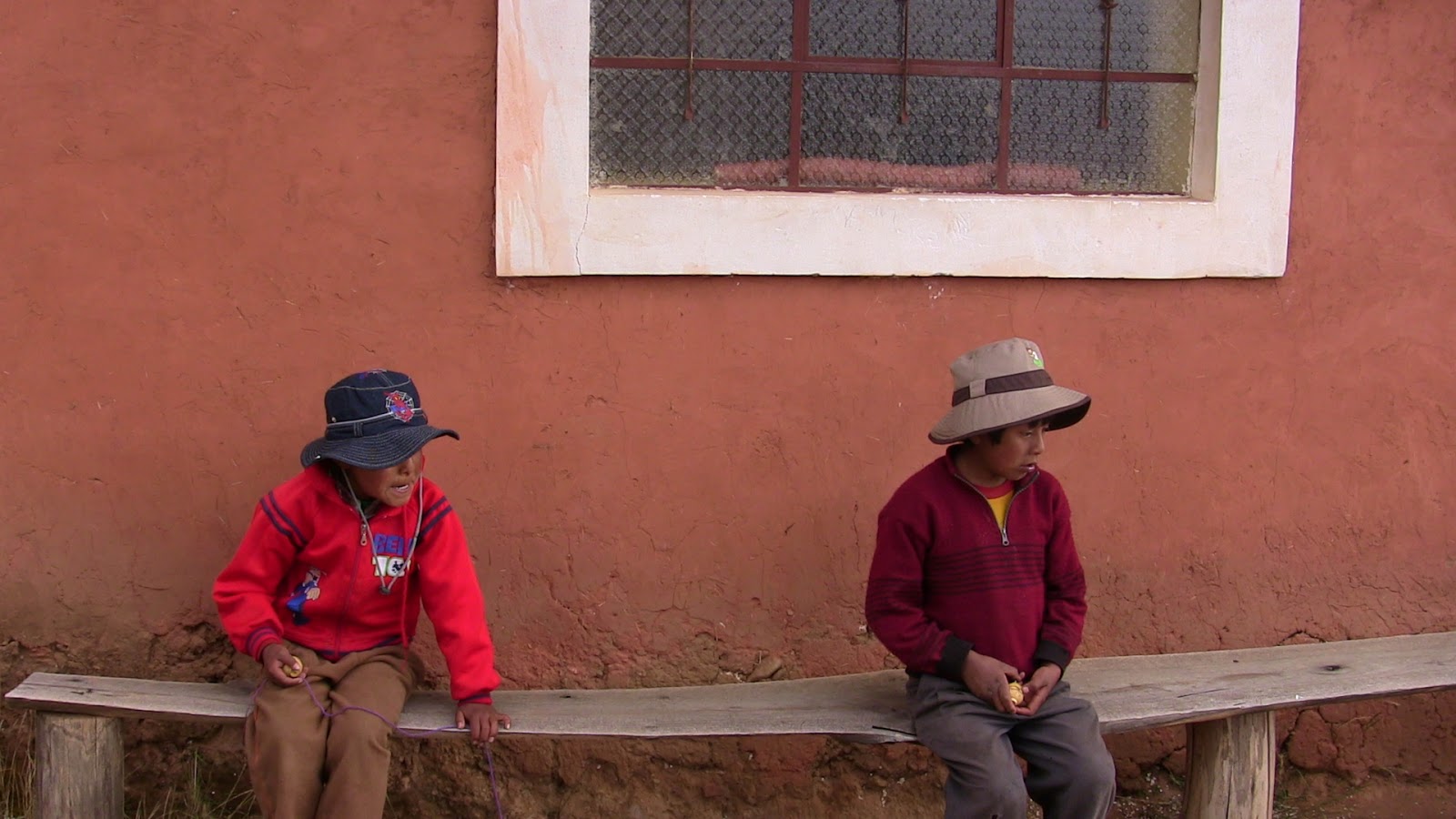
Children on the island of Amantani, playing games with tops
 We stayed that night on the island of Amantani with a local family. They made us beds and cooked lunch, dinner, and breakfast the next morning using their primitive kitchen and local, natural ingredients. The food was incredible. Very simple, yet very delicious.

That night there was a party on the island celebrating the Pentecost, and our family lent us some traditional garb to wear. Their young daughter taught us how to dance (which was basically holding hands in a group and spinning in a circle while jumping up and down). We were able to master the dance fairly easily.

Once again, Derek's stomach didn't like the idea of dancing in circles. He couldn't join us.

 In the morning we said goodbye to our gracious host family and visited one more island on the lake. There wasn't much new on this island, that is, except for more amazing terrain and views of the lake. We explored the island for a bit and then left on a 3 hour boat ride back to Puno.

We met some great local families and also fellow travelers from around the globe. We became friends with two brothers from Germany and are now staying at the same hostal together, preparing for our bus ride tomorrow to La Paz, Bolivia.
View of the land on one of the islands of Lake Titicaca.
 Peru has been magical, but now it's time to continue on. 'Til next time.    

    ~Dustin

Thursday, May 16, 2013

Been there, hiked that. The thrill of Machu Picchu

Machu Picchu before the tourists arrive

We woke up at about 3:45am to start the final hike up to the ancient city. We left at about 4:30 and arrived around 6am. As the doors opened, I ran as fast I could to a high part so that I could get the coveted photo of Machu Picchu with the sun rising and still not a single tourists tainting it. I got it! I can come home now, ok Im not going to but that was a big check mark off my list for our trip. 

As the day went on, we found all sorts of amazing buildings and temples that each seemed to have religious significance. The temple of the sun, temple of the priests, and of the temple of the condor. We kept imagining how Hyrum Bingam found this beautiful city with trees and vegetation covering its many carved out agricultural layers and rock formations. You can tell here on the right how there is a bird carved out with its two  wings behind its body and the face and eyes are on the ground where a rope is keeping tourists from stepping on it.

Some of the most interesting structures where the ones with these square blocks that are still the original ones found. There were cut with so much precision and expertise that it was interesting to think what kind of tools they were using. Only 30 percent of the archeological sight has been reconstructed, you can easily tell what has been redone, so it was nice to determine exactly what was original.


Then we spotted a group of tourists, very brightly dressed, praying in their own faith over the mirror pools. We dont exactly know what these were used for, we just know that it had something to do with reflection. Maybe these guys knew and just weren't willing to fill us in, but it was kind of interesting to see what they were doing.


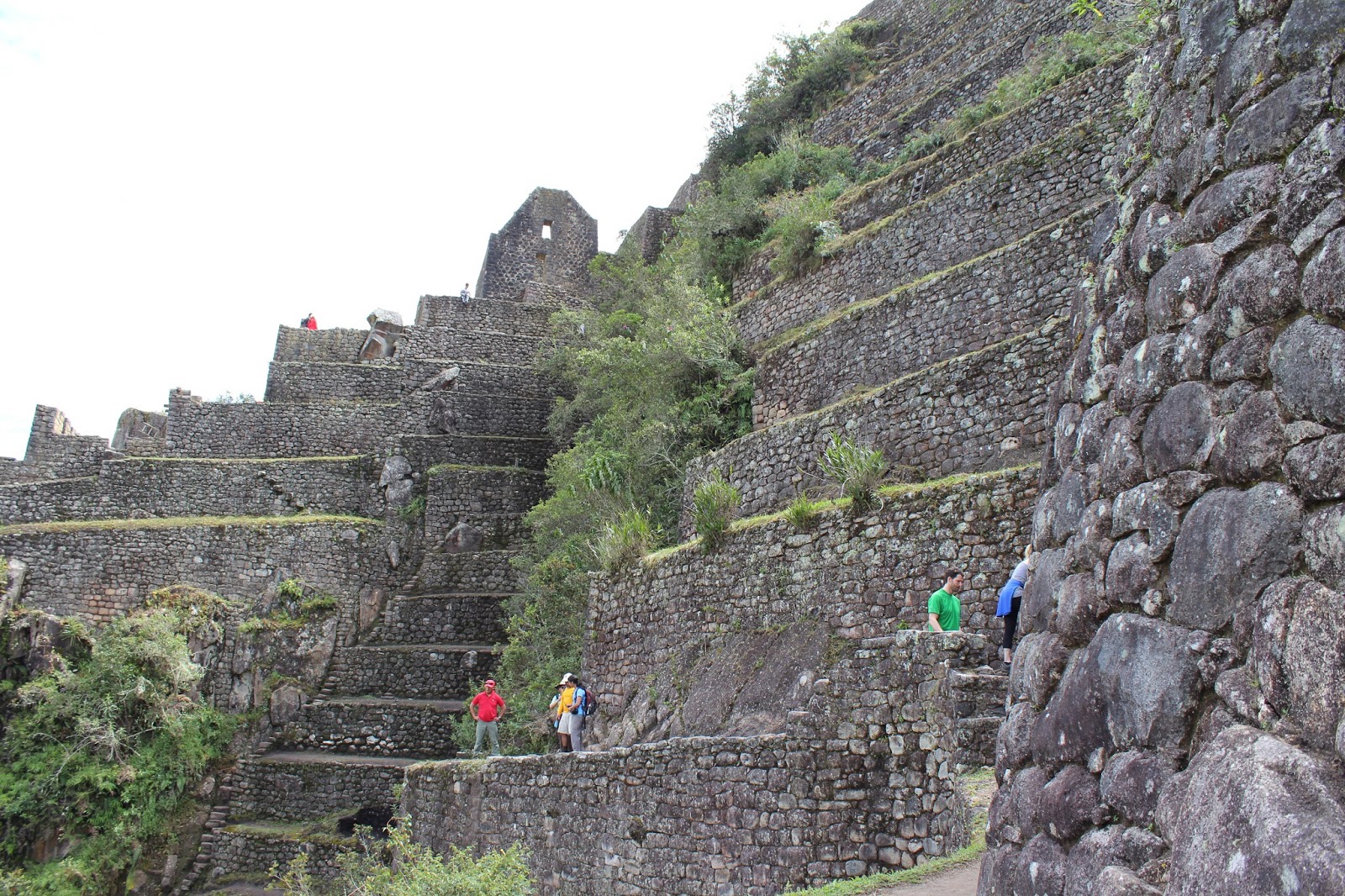
We wanted to see Machu Picchu from a little higher up, so we hiked the super steep patch to Huanaypicchu, or Waynaypicchu, it was spelled both ways on the same trail. But it was a mazing to imagine how the high priests of the town, probably the older elders, hiked such a crazy cliff to arrive at their places of worship. Everything was defintely built for a smaller generation of people. Even the steps seemed reasonable for an infant. 


So thats it! We hiked for 5 days starting about an hour or two outside of Cuzco and after over 30 miles of the Andes, hiking about 9 hours a day, we arrived to our destination. It was fun, we recommend it to hikers all over, it was hard but doable. We just want to tell our families that we are safe, resting a bit in Cuzco right now in an awful hostal with out hot water, but life is good. We have just over 3 weeks left. Next stop, Puno, Peru and the Floating Islands. Stay tuned, and remember, there is a world beyond...